

PU foam and compatibility with building materials: How to get it right with the correct substrate
Anyone who wants to know which materials PU foam adheres to and how compatible it is often only finds brief statements:
PU foam adheres well to most building materials such as concrete, plaster, masonry, fibre cement and wood, as long as they are clean and dry. Often, it simply says: "Does not adhere to dusty or oily surfaces."
But what exactly is behind this statement? How reliable really is the adhesion to different building materials? What factors play a role – and what can be done if the substrate is not ideal?
Together with a chemist, we took a closer look at the topic and explain what matters in practice.
What does "compatibility" really mean in relation to PU foam?
On which surfaces does PU foam adhere well?
What to do with difficult surfaces?
When should PU foam not adhere?
Which environmental factors influence adhesion?
Discolouration after cleaning? This is the reason
Protecting PU foam: What is suitable as covering?
Conclusion
What does "compatibility" really mean in relation to PU foam?
In everyday life, the term is often used imprecisely. In most cases, it is simply a matter of adhesion to a substrate.
From a chemical point of view, however, this can also refer to interactions that cause problems in the long term.
In practice, two points are crucial:
- How well does the foam adhere to the respective material?
- Is the foam compatible with the material over the long term without permanently attacking it?
On which surfaces does PU foam adhere well?
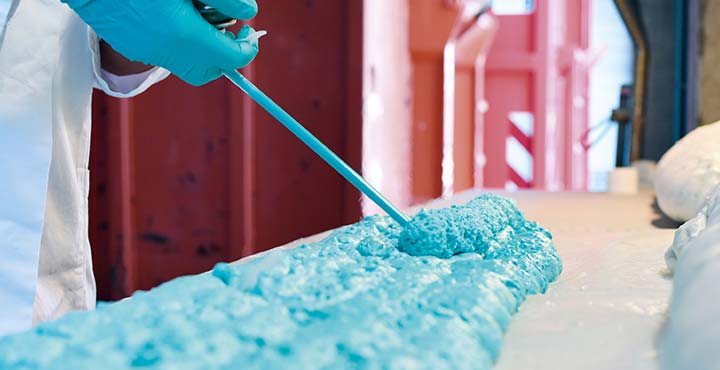
In general, PU foam adheres excellently to absorbent, porous building materials. These include:
- Concrete: The rough surface provides optimum grip for the foam.
- Brickwork: Porous, unsealed and therefore ideal for PU foam.
- Wood: a natural material with open pores to which the foam reliably adheres.
- Calcium silicate brick or aerated concrete: Very well suited due to their open-pored structure.
Many other mineral substrates also bond easily with PU foam.
Special case: plaster
Plaster is absorbent, but often very dusty. In this case, the foam does not adhere to the solid surface, but only to the dust – and can be easily removed later.
Tip: A simple measure is to wipe the surface thoroughly with a damp cloth. This can improve adhesion in the short term, but is not ideal: the foam may then only adhere superficially, which can be problematic for permanent applications.
If you want to be on the safe side, treat the surface with deep primer or other suitable primer. This reliably binds the dust and creates a stable, adhesive-friendly surface.
Good to know: Deep primer from a DIY store is often ideal as a primer on plaster or lime substrates.
PU foam only adheres to stable surfaces
One basic principle is that the foam’s adhesion is only as good as the substrate is stable. If the top layer of a material can be easily rubbed off or crumbles, no permanent bond will be formed. Crumbling plaster or old paint residue are good examples of such substrates.
The foam then only adheres to this unstable layer and can detach again together with it. Such surfaces should therefore be thoroughly inspected, cleaned or pre-treated before work.
Adhesion of construction foam to metals
Metals represent another special case. Metals with rough or at least unpolished surfaces – such as structural steel or galvanised sheet metal – are generally used on construction sites. These surfaces usually provide sufficient grip for PU foam, especially at the contact points.
Problems arise with smooth or polished metals, such as stainless steel or those with finished surfaces. Here, the PU foam – which ultimately acts as an adhesive – finds little grip, as it cannot 'claw' into the structure of the surface. In such cases, the following helps:
- Roughen the surface, preferably crosswise with sandpaper
- Or prime with a primer suitable for PU foam
Does PU foam adhere to plastics and glass?
With plastics, adhesion is often difficult. PU foam is usually not a good choice for smooth, non-absorbent surfaces.
The situation is similar with glass:
Although PU foam can also adhere to glass, adhesion depends heavily on the surface treatment.
The foam only adheres moderately to untreated glass. However, with the right primer, the adhesive strength can be significantly improved – even on smooth glass surfaces.
Avoid oily and greasy surfaces
PU foam does not adhere to oily or greasy surfaces. They are considered a classic negative example when it comes to PU foam adhesion. Why? The foam cannot adhere to such surfaces and slides off – similar to a release agent.
Oil films can occur, particularly on metallic or machined parts, and must be removed before foaming.
Thorough degreasing with suitable cleaners or, if necessary, additional sanding of the surface will help here. PU foam is usually not the first choice, especially for smooth, non-absorbent plastic surfaces.
What to do with difficult surfaces?
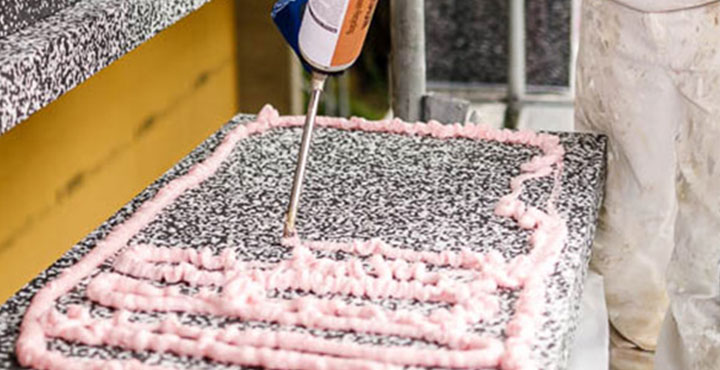
Not every surface is immediately suitable. But with a little preparation, it will still work:
- Dusty surfaces (e.g. plaster): First clean and treat with deep primer if necessary.
- Shiny metals: Sand down and/or use primer.
- Difficult plastics: Check for alternatives or work with a PU-compatible bonding agent.
Primers: The invisible helpers
Primers – i.e. bonding agents – are available for many substrates. They improve the adhesion of PU foam, for example on metal, plastic, glass or dusty walls.
So-called universal primers, which are suitable for many substrates, are available from retail outlets. A suitable primer significantly improves adhesive strength, especially on metal, plastic or glass.
A primer (e.g. deep primer) is also recommended on plaster or chalky walls to bind loose particles.
Practical tip:
Not every primer works equally well on every surface. If in doubt, seek advice from a specialist retailer or follow the manufacturer's recommendations.
When should PU foam not adhere?
Sometimes it is desirable for the foam not to form a permanent bond – for example, in temporary constructions.
This can be achieved by covering surfaces with adhesive tape or using release agents or films. This makes it easy to remove the foam later.
Important in everyday use:
When working with PU foam, it is always advisable to cover adjacent surfaces that should not come into contact with the foam, such as door or window frames, floor coverings or furniture parts. This prevents excess foam from sticking where it is not wanted and becoming difficult to remove.
Which environmental factors influence adhesion?
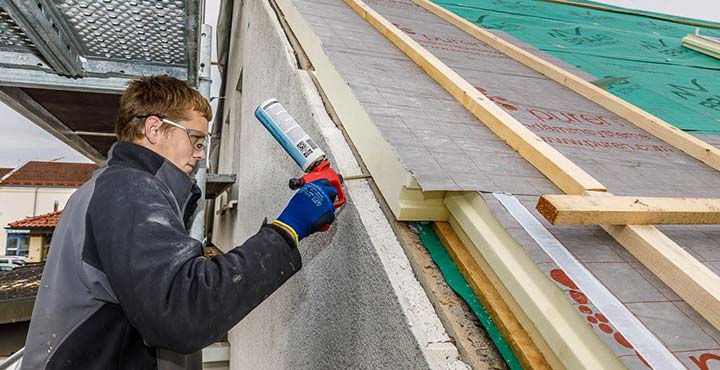
Temperature and humidity play a greater role in the processing of PU foam than many people think. They have a significant impact on both the adhesion and curing of the foam:
- Below 0 °C: Take care if ice forms on the surface. The foam does not stick to ice. In addition, incomplete curing may occur at very low temperatures.
- Too dry: PU foam requires moisture from the air or the substrate in order to cure properly. If the ambient air is too dry, the foam cannot cure properly because it lacks the necessary moisture.
In these cases, lightly spraying the surface with water before application is recommended – for example, using a spray bottle. But be careful: too much water will cause excessive foam expansion. - Too hot: On overheated surfaces – for example, metals exposed to the midday sun – the propellant gas in the foam can escape too quickly. Bubbles form, significantly reducing adhesion. In these cases, either wait for a shady spot or cool the area down beforehand.
Practical tip:
The processing temperature range for construction foam is between +5 °C and +35 °C. Within this range, the foam and substrate work together best – both in terms of adhesion and subsequent hardening.
Discolouration after cleaning? This is the reason
Chemically, PU foam is extremely stable and does not actively attack most substrates. However, when it hardens, it bonds very strongly to the surface – similar to an adhesive. This means that when the foam is later removed, it can leave visible marks or discolouration, even if the material itself is not damaged.
A typical example: foam residue that has dripped onto window frames or painted door frames is removed, but a shadow is left behind.
Things become particularly tricky when dissolving fresh foam with acetone or PU removers. These agents transport the dissolved PU components into the surface – for example, into wood or varnish. They are not visible at first, but discolour over time due to exposure to light and reappear weeks later as yellowish or brownish spots.
Our recommendation:
Allow the foam to harden as much as possible and then remove it mechanically, e.g. with a scraper. Carefully sand down any residue. Solvents should be avoided as much as possible on sensitive surfaces such as painted areas.
Protecting PU foam: What is suitable as covering?
PU foam is extremely resistant to mechanical stress, moisture and many chemicals. Nor does it attack the substrates.
However, PU foam is not light-resistant!
Light, and especially direct sunlight, breaks down the foam over time, making it brittle and crumbly and leading to significant discolouration. This is not just a visual problem. Over time, this can cause damage that impairs the protective and insulating function of the foam.
It is therefore essential to cover PU foam reliably after curing – especially outdoors and wherever exposure to light is to be expected.
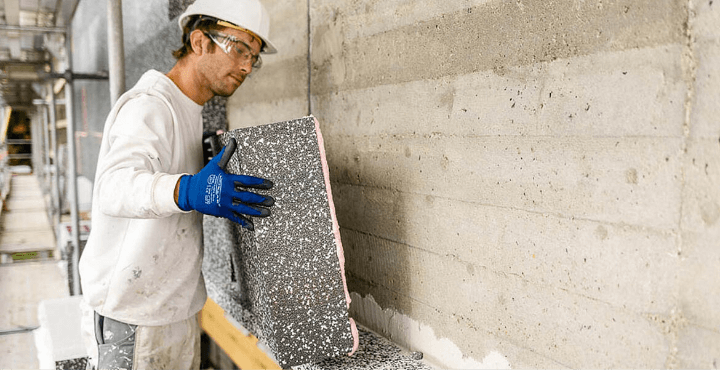
Almost all common coatings are suitable for covering:
- Varnishes and paints (including solvent-based)
- Plaster, silicone or sealants
- Bituminous products, provided they do not contain aggressive solvents
If the foam is very porous, e.g. because you have cut into it, it may be advisable to apply several coats to achieve an even and closed protective layer.
Conclusion: Good preparation is half the battle
PU foam works reliably on many surfaces – but not automatically on all of them. Knowing the characteristics and preparing the substrate properly give a clear advantage.
Clean, suitable substrates, a glance at the thermometer and good coverage after curing – these are the key factors for consistently good results.
PU foam is robust, versatile and adheres to almost all common building materials – provided you follow a few basic rules. With prepared surfaces, the right ambient temperature and suitable covering material, craftspeople and DIY enthusiasts are on the safe side. And if something does go wrong: stay calm, let it harden and remove it mechanically – this will keep everything clean and permanently stable.
This may also interest you
![[Translate to Englisch:] PU-Schaumarten](/fileadmin/PU-Schaum-Center/PU-Schaumarten/img_PU-Schaumarten_bauschaum_produkt_viele_namen.png "[Translate to Englisch:] PU-Schaumarten")
PU foam types: Overview of most important types of PU foams
![[Translate to Englisch:] Bauschaum entfernen](/fileadmin/PU-Schaum-Center/PU-Schaum_in_der_Praxis/img_Bauschaum_entfernen.jpg "[Translate to Englisch:] Bauschaum entfernen")
Removing construction foam
![[Translate to Englisch:] FAQ PU-Schaum](/fileadmin/PU-Schaum-Center/PU-Schaum_in_der_Praxis/img_Praxis_FAQ.jpg "[Translate to Englisch:] FAQ PU-Schaum")