
The most frequently asked questions about PU foam
Filling an inflatable boat with PU foam? Keeping mice away with construction foam? Or insulating a motorhome?
As unusual as these questions may sound – they have actually been put to us and have, in some cases, surprised even us. Every year, the PU Foam Info Centre receives enquiries from DIY enthusiasts and professionals alike. From these, we have selected and answered the nine most frequently asked questions.
Can’t find your question here? Further down, you’ll find many more FAQs as well as detailed information on the processing and application of PU foam.
We would generally advise against this. PU foam often does not cure evenly in such enclosed cavities because there is frequently insufficient humidity for uniform curing. At the same time, it is difficult to distribute the foam in a controlled manner within such structures. This can result in deformations, bulges, and an unsightly appearance.
Regular PU foam can help seal openings and cracks initially. However, it alone does not provide permanent protection against rodents or insects. For long-term protection against rodents, additional mechanical barriers such as wire mesh or metal sheets are the best option. Steel wool also works well for mouse holes.
Specialized foams promise a simple solution; they contain added odorants that deter rodents from eating them.
Heat and freezing cold have little effect on PU foam that has already cured. Depending on the product, it can often withstand temperatures as low as about –40 °C and as high as over +80 °C.
Different temperature limits apply to the application process than to fully cured PU foam. Standard PU foam should generally not be applied at temperatures below about +5 °C. The optimal processing range is usually between approximately +25 and +30 °C. Details for the product you are using can be found in the manufacturer’s respective product data sheet. Outside these specified temperatures, the foaming and curing behavior can change significantly.
Special winter foams are available for lower temperatures. These can often be applied down to about –10 °C. For countries with very cold winters, there are also some special foams designed for application down to about –20 °C.
Important: The temperature limits for application do not automatically apply to the fully cured foam.
PU foam can be used to secure components, provide insulation, or fill cavities in certain applications. A classic example of this is the installation of interior doors. However, PU foam is generally not suitable for load-bearing or structurally critical applications.
This applies, for example, to reinforcing beams, stabilizing load-bearing structures, or permanently supporting heavy loads. Even though cured PU foam can appear quite firm depending on the product, it is not a substitute for building materials or fastening systems designed for these purposes.
For structurally critical applications, a suitable structural solution should therefore always be chosen.
No. Yellowed PU foam is not considered harmful to health. The yellowing is primarily caused by UV light or sunlight and is, at first, mainly a cosmetic change.
If PU foam is exposed to light unprotected for a very long time, the surface can become brittle over time and slowly degrade. Therefore, exposed PU foam should be permanently protected from UV radiation, for example with plaster, paint, or covers. However, yellowing itself is not an indication that the foam has suddenly become harmful to health.
PU foam can generally be used in vehicles, for example for insulation or to secure certain components such as shower pans. It’s important to note that vehicles are exposed to vibrations and movements while driving. Therefore, a flexible PU foam should be used whenever possible, as it can withstand these stresses over the long term without tearing.
You can often tell whether a foam is flexible just by looking at the product name. Terms like “flexible” or “elastic” provide a clue. Alternatively, it’s worth checking the product data sheet. Flexibility is described as a percentage: the higher this value, the more flexible the foam.
You can find more details at the following link: https://www.pu-schaum.center/pu-schaumarten/qualitaet-bauschaum#c8259
However, caution is advised when filling larger cavities in vehicle bodies or wall structures—such as in RVs, panel vans, or trailers. Moisture can accumulate in these areas. If such areas are filled with foam, trapped moisture can promote corrosion. Furthermore, subsequent repairs become significantly more difficult.
Anyone wishing to insulate a vehicle should therefore carefully assess which requirements must be met: insulation performance, moisture, weight, reparability, and movement while driving all play an important role. For larger areas, insulation boards or other insulation materials may be the better solution under certain circumstances.
PU foam is generally not suitable for permanently sealing leaks. This applies, for example, to leaky water or heating pipes, leaks in buildings, or other areas where water continuously penetrates or pressure is exerted on the seal.
The reason: PU foam is not durable enough for such applications. Water, moisture, or pressure can cause the seal to fail over time.
While PU foam can fill cavities or seal joints, other solutions are generally better suited for repairing actual leaks or creating permanently tight connections.
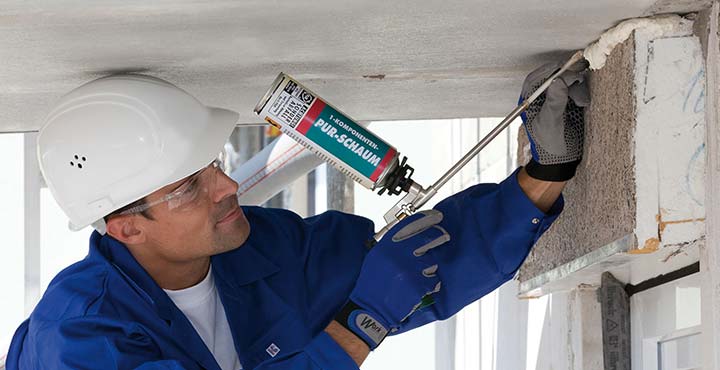
Generally speaking, yes. For many types of insulation boards, there are special PU adhesive foams designed for both bonding and insulation. They are used, among other things, on facades, basement ceilings, and garage ceilings.
However, it’s important to consider the appropriate substrate, the weight of the insulation boards, and any manufacturer specifications or system approvals. Depending on the application, additional fasteners may be recommended or required.
If you want to install insulation boards with PU foam, you should find out in advance which solution is suitable for your specific application. You can find more information here:
PU adhesive foam for bonding and insulation
; bonding exterior facade insulation with PU foam adhesive
We would generally advise against this. PU foam often does not cure evenly in such enclosed cavities because there is frequently insufficient humidity for uniform curing. At the same time, it is difficult to distribute the foam in a controlled manner in such structures. This can result in deformations, dents, and an unsightly appearance.


This may also interest you

14 application fields of PU foam
Practical tips: How to use construction foam